


Follow Us


Design-build remodeling in Chicagoland since 2006
Home → Blog → Bathroom Sink Types and Shapes: How to Choose the Right One
November 25, 2026

In this article
Quick Answers Types of Bathroom Sinks Bathroom Sink Shapes How to Choose the Right Sink Size One Sink or Two? Bathroom Sink Materials Match the Sink to the Bathroom Cost and Timeline for a Bathroom Remodel Frequently Asked QuestionsThe best bathroom sink depends on how the bathroom is used, how much counter space you have, and the look you want. Undermount sinks are a popular choice for everyday bathrooms because they're easy to clean. Vessel sinks make a statement in powder rooms. Rectangular basins give you the most usable space, and oval basins soften a room. Below, our design-build team walks through each sink type, shape, size, and material so you can choose with confidence.
Six bathroom sink types
Side view. How each sink meets the counter.
SinkCountertopVanity
Undermount
Attaches below the counter. No rim, so you wipe straight into the basin.
Easiest to cleanPrimary and family baths
Drop-in
Sits in a cutout with its rim on top of the counter. Works with almost any countertop.
Simple to replaceRim needs more cleaning
Vessel
Sits on top of the counter like a bowl. Needs a tall or wall-mounted faucet.
Statement lookPowder rooms
Integrated
Made from the same piece as the countertop. Seamless and easy to wipe down.
Easiest to cleanDamage can mean a new top
Wall-mount
Attaches to the wall with no vanity below. Saves floor space.
No storagePowder rooms, small baths
Pedestal or console
A pedestal stands on one column. A console stands on two or four legs.
Classic lookLittle to no storage
An undermount sink attaches below the countertop, so there's no rim to catch water or grime. You can wipe the counter straight into the basin. It works best with solid countertops like quartz, granite, or marble. This is the sink we recommend most for primary and family bathrooms.

Arlington Heights bathroom: an undermount sink in a white quartz top with a brushed brass faucet.
A drop-in sink sits in a cutout with its rim resting on top of the counter. It's simple to install and replace, and it works with almost any countertop. The tradeoff is the rim, which collects water and needs more cleaning.
A vessel sink sits on top of the counter like a bowl. It works well in a powder room where you want the sink to be the focal point. Plan the faucet with it: a vessel sink needs a tall faucet or a wall-mounted faucet. Vessel sinks can also splash more and are harder to clean around the base.

Wilmette bathroom: a vessel sink on a floating black vanity with a quartz top.
An integrated sink is made from the same piece as the countertop, often quartz, solid surface, or stone. With no seams, it looks clean and modern and is easy to wipe down. If the sink gets damaged, though, you usually replace the whole top.
A wall-mount sink attaches directly to the wall with no vanity below. It saves floor space and makes a small bathroom feel larger, but you give up storage. It works well in powder rooms and small guest baths.
A pedestal sink stands on a single column. A console sink sits on two or four legs. Both bring a classic look, especially in older homes, but offer little to no storage. Consoles usually give you a bit more counter space than pedestals.
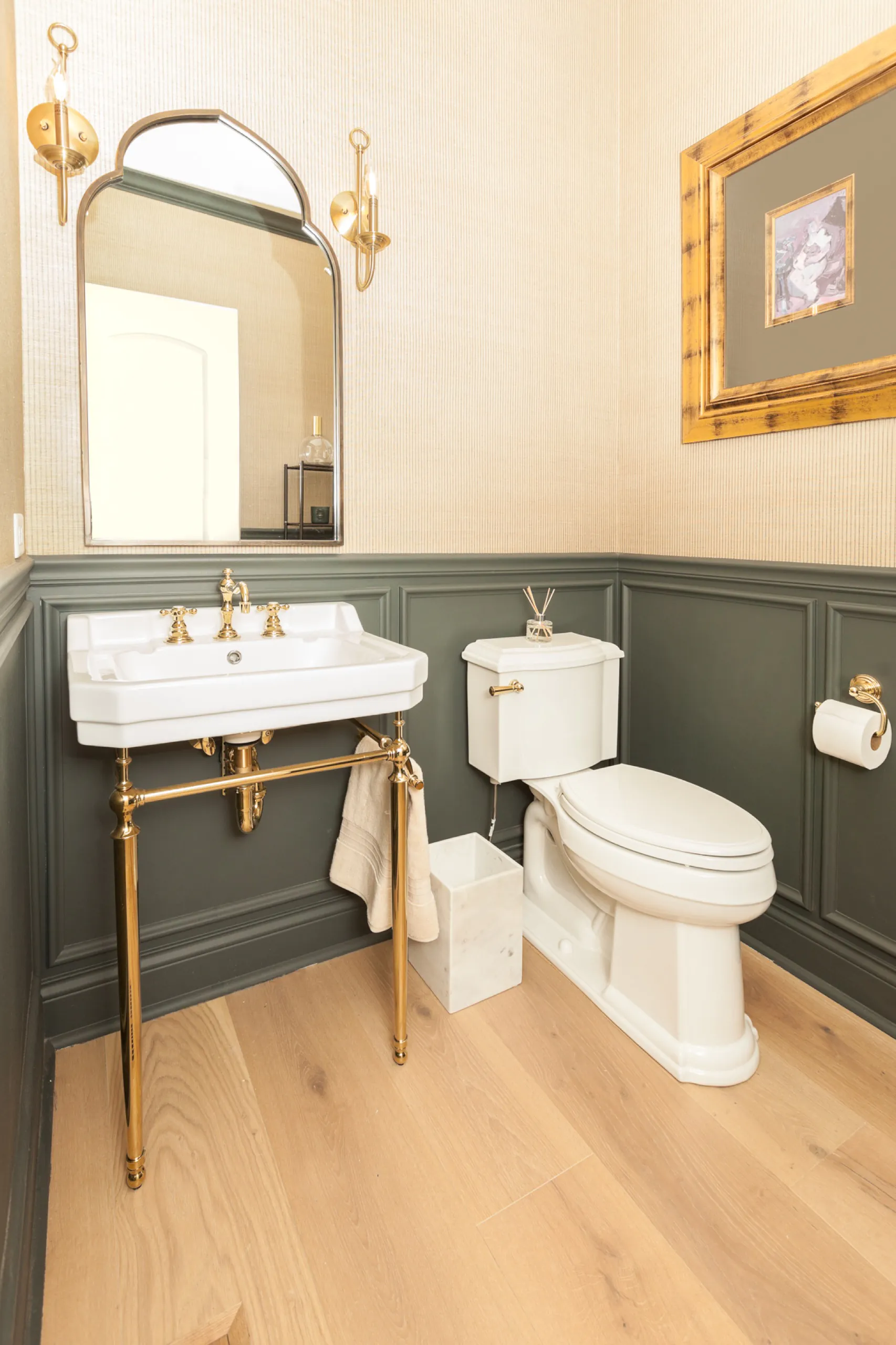
Elmhurst powder room: a brass console sink with green wainscoting and an arched mirror.
Four basin shapes, same counter
Top view. The red area is the basin.
Rectangular
Most usable basin space. Matches straight-lined vanities.
Oval
Softens the vanity and fits most counter depths.
Round
Soft and sculptural, with less usable space.
Square
Crisp and architectural. Needs a deeper counter.
Rectangular basins give you the most room for washing your face, rinsing, and daily tasks. They match the straight lines of most vanities and suit modern and transitional bathrooms.
Oval is a classic shape. It softens the hard lines of a vanity and fits most counter depths well. It's a safe, flexible choice for almost any style.
Round basins work well as vessel sinks or in small vanities. They look soft and sculptural but offer less usable space than a rectangle the same width.
Square basins look crisp and architectural. They work best on deeper counters and in modern bathrooms. Check the depth, because a square basin can crowd the faucet on a shallow vanity.
Size the sink to the vanity and to how the bathroom is used.

Bartlett bathroom: an undermount sink in a white quartz top with counter space on both sides.
Two sinks make sense in a primary bathroom shared by two people who get ready at the same time. The vanity has to be long enough to give each person counter space. If it isn't, a single sink with more counter and storage is often the better choice. We cover more primary bath layout ideas in our luxury bathroom guide.

Elmhurst bathroom: double undermount sinks on a dark stone top with pivot mirrors.

Arlington Heights primary bathroom: a wood double vanity with a sink on each side of the window.
Bathroom sink materials
What each looks like and what to watch for.
Vitreous china
Durable, glossy, and easy to clean.
Quartz or solid surface
Seamless look for integrated sinks.
Natural stone
High-end look.
Watch for: needs sealing
Glass
Popular for vessel sinks.
Watch for: shows water spots
Metal
Copper or stainless for a warm or industrial look.
Watch for: each shows wear differently

Deerfield bathroom: an undermount sink in a dark stone top on an oak vanity.
Which sink for which bathroom
A quick match by room.
Primary bathroom
Undermount or integrated
Rectangular or oval, single or double
Kids' or family bath
Undermount
Deeper basin, durable material
Powder room
Vessel, wall-mount, or pedestal
Chosen for looks
Small bathroom
Wall-mount or compact vanity sink
Saves floor and counter space
Basement bathroom
Undermount
Simple and durable
For the full bathroom, the sink should match the rest of the room. For calm, tone-on-tone ideas, see our neutral bathroom ideas.

Evanston powder room: a floating oak vanity with a black faucet and black framed mirror.
The sink is one piece of the full bathroom. Based on our bathroom remodel cost guide, guest bathrooms with us often run $40,000 to $60,000, and primary bathrooms often run $80,000 to $100,000. Guest baths usually take 4 to 6 weeks, and primary baths take 8 to 12 weeks once the design is final. See how long a bathroom remodel takes.
Undermount sinks are among the most popular for primary and family bathrooms. They sit below the counter, which makes the counter easy to wipe clean and gives a smooth, modern look.
Rectangular sinks are usually the most practical because they offer the most usable basin space. Oval sinks are a close second and soften the look of the vanity.
Vessel sinks work well in powder rooms where looks matter more than daily use. In busy bathrooms they can splash more and are harder to clean around the base, so many homeowners choose undermount sinks there.
Two sinks work well if two people get ready at the same time and the vanity is long enough to give each person counter space. If space is tight, one sink with more counter and storage is often the better choice.
Undermount and integrated sinks are the easiest to clean because there is no rim between the counter and the basin. You can wipe water and debris straight into the sink.
Choosing the sink is easier when you see it with the vanity, the faucet, and the rest of the room. Our design-build team shows you 3D concepts so you can compare options before anything is ordered. Learn more about our bathroom remodeling, or visit our showroom at 1201 Norwood Avenue in Itasca.
Schedule a Free ConsultationConsultation
"*" indicates required fields
Mon – Fri:
Sat:
Sun:
9 AM – 5 PM
By Appointment Only
Closed
Hours