


Follow Us


Design-build remodeling in Chicagoland since 2006
Home → Blog → 9 Home Remodel Mistakes Homeowners Make & How to Avoid
Updated October 29, 2026
Avoid these 9 home remodeling mistakes: rushing decisions, vague quotes, no budget buffer, and more. Simple fixes from our Chicagoland design-build team.

Marc Santarromana
In this article
9 Home Remodeling Mistakes Homeowners Make (And How to Avoid Them) Key Takeaways What are the most common home remodeling mistakes? Your quick checklist before you start a home remodel Frequently asked questions The takeaway: avoid home remodeling mistakes by slowing downThe most common home remodeling mistake is rushing. Most people remodel only once or twice, so most homeowners are learning as they go. The good news is that the same remodeling mistakes show up again and again, which means you can see them coming. Below are nine mistakes homeowners make during a home remodel, and simple ways to avoid each one.
The biggest remodeling mistake is rushing decisions just to be done.
Plan for how you’ll use your space in five years, not just today.
Get a detailed, itemized quote, and make sure your space is measured first.
Set aside a 10–15% buffer, and expect the timeline to take time.
Use Pinterest and AI for inspiration, not as a plan.
Keep permanent surfaces neutral and add bold color where it’s easy to change.
Here are the nine most common home remodeling mistakes, in the order they tend to happen.
Not planning for how you’ll really use the space
Treating Pinterest and AI images like a plan
Accepting a vague quote
Skipping the measurements
Not setting aside a budget buffer
Expecting the project to move faster than it can
Not preparing for life in a remodel
Going bold on things that are hard to change
Rushing decisions
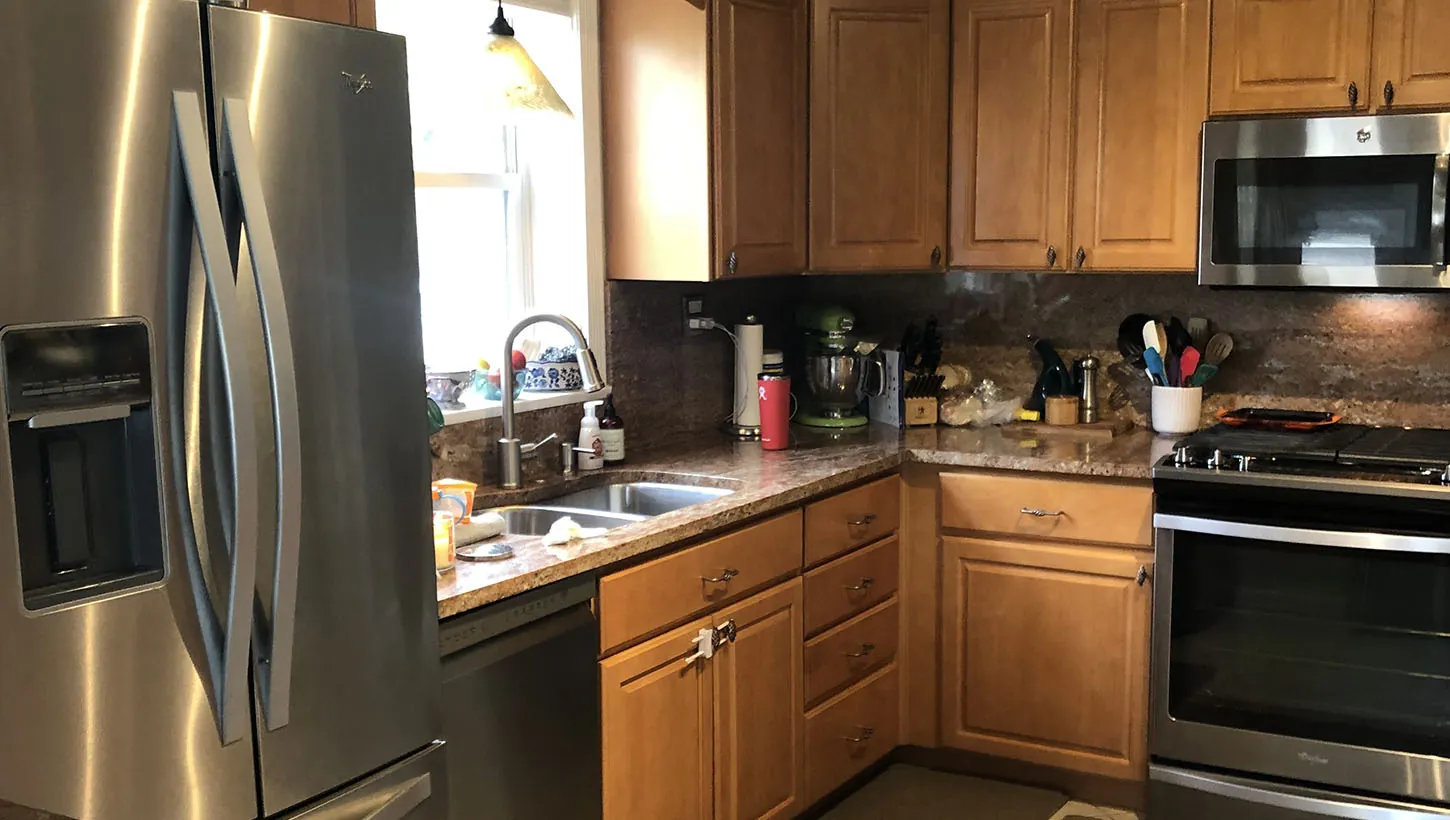
A Lombard kitchen before its remodel.
Planning only for today is one of the most common remodeling mistakes. It’s natural to design around the life you have now. For example, if you don’t have kids, extra storage might not feel important. A few years later, you wish you had it. Layout and cabinets are some of the most expensive things to change later, so a design that fits your life now but not in five years can mean living with a space that frustrates you, or paying to redo it.
How to avoid it: Before you choose a layout, ask yourself these questions:
Who uses this room, and how often?
Do I cook a lot? Do I entertain, and how many people usually come?
Might my household change in the next five years?
Does this layout fit the size of my home?
Hosting a big group in a small house, for example, might mean opening up walls, which can mean giving up an island or some living space. Pick the layout that fits how you live, not the one that looks best in a photo. See our guide to open vs. closed kitchen layouts for more.
Inspiration photos are great, but many can’t actually be built. Some show kitchens that wouldn’t work in real life, and AI images often ignore outlets, measurements, and walkway space. A cabinet that looks perfect in a picture might leave no room to walk between it and the counter.
How to avoid it: Use Pinterest and AI to show your designer the colors, finishes, and overall feel you like. Then let a designer check what works in your real space. Read more in AI kitchen design: can you trust it?
A one-line quote can leave out things you assumed were included. A line that just says “trim,” for example, might cover labor only, not materials. When something’s missing, it shows up later as an extra cost. Detail is hard to find. In a Houzz survey of 2,866 U.S. homeowners, 34% said obtaining detailed proposals was a challenge when looking for a professional. (The survey covers Houzz users doing kitchen and bath renovations.)
How to avoid it: Ask for a detailed quote and read it line by line. Before you sign, make sure you know:
What’s included, and what isn’t
Whether each line covers labor, materials, or both
Who handles permits and ordering
What happens if something unexpected comes up
The Federal Trade Commission also suggests getting multiple written estimates and not automatically choosing the lowest bidder. For more, see design-build vs. general contractor.
If nobody has measured your space, a quote is just a guess. That can mean a missed load-bearing wall, which needs temporary support and a beam, or a materials estimate that’s off, which leads to waste and surprise costs.
How to avoid it: Make sure anyone quoting your project has measured your space first. If someone gives you a firm number without visiting, ask how they got it.
Even a well-planned remodel can run into surprises. Sometimes it’s something hidden behind a wall. Other times, it’s you deciding you want something extra. Without a buffer, a small surprise becomes a stressful one.
How to avoid it: Add 10 to 15% on top of your budget before you start, and keep it separate from your main budget. If you don’t need it, great. See our Chicago kitchen remodel cost guide for what affects the price.
A lot of a remodel’s timeline is out of anyone’s hands. Design takes time, towns take time to approve permits, and custom items like cabinets take time to build. So a project you hope will take two months can run much longer. Timelines matter to homeowners: in the same Houzz survey, 41% said a clear project timeline would have improved their renovation experience.
How to avoid it:
Ask how long permits usually take in your town
Ask when long-lead items, like cabinets, need to be ordered
Get a timeline in writing, and ask what could change it
Plan around a realistic schedule, not the best case
It’s easy to picture the finished kitchen and forget the weeks it takes to get there. When people are working in your home, it gets dusty and loud, and some days the water or power may be off. None of that is a dealbreaker, but it feels a lot worse when it’s a surprise.
How to avoid it: Ask what the loudest and messiest days will be and when utilities will be shut off. Then plan around it. That might mean setting up a temporary kitchen, adjusting your work-from-home days, protecting furniture, or staying somewhere else for the roughest few days.

A kitchen renovation in progress in Itasca.
Trends come and go, but cabinets and flooring stay. A bold choice that feels exciting now may feel dated later, and it can make your home harder to sell.
How to avoid it: Keep the permanent elements neutral and add color in things that are easy to swap, like paint, rugs, pillows, and accessories. Bold can still work if it’s easy to undo. Painting a room one dark color from walls to trim, known as color drenching, is popular right now, and you can paint it back later. Also balance dark with light. If you choose dark cabinets, add lighter tones in the walls, floors, or backsplash. For cabinet ideas, see our comparison of custom cabinets.
Rushing is the home remodeling mistake homeowners regret most. A remodel is hundreds of choices: cabinets, countertops, tile, lighting, faucets, and more. By the middle of the project, most people are tired and just want to be done, so they pick whatever’s fastest to check it off the list. Afterward, they wish they’d added the spice rack or put a pot filler above the stove.
How to avoid it:
Keep an “I wish” list as you go, and bring it to your designer before plans are final
Make big decisions early, when you have time, instead of under pressure
For each major choice, ask: “Will this still work for us in five years?”
If someone pushes you to decide on the spot, pause
I know how I use the space now and how it might change.
I’ve shared inspiration photos, but I’m letting a designer check what’s possible.
My quote is detailed, and I understand what’s included.
My space has been measured.
I’ve set aside a 10–15% buffer.
I’ve asked about permit and ordering timelines.
I have a plan for the dust, noise, and utility shutoffs.
I’ve chosen neutral for the permanent stuff.
I’m giving myself time to decide.
Rushing. Homeowners most often regret making decisions just to check them off the list. Decision fatigue leads to quick choices that don’t hold up over time.
Set aside 10–15% on top of your budget for unexpected costs and things you decide to add along the way.
It depends on the project. Design, permits, and custom orders all affect the timeline, and a remodel often takes longer than people expect. Ask for a written schedule and what could change it.
The same ones: not planning for how you’ll use the space, accepting a vague quote, skipping measurements, not budgeting a buffer, and rushing decisions. See our kitchen remodeling projects for real examples.
Skipping the planning stage, not budgeting for surprises, and not thinking about how the addition connects to the rest of the house. Read our guide to home addition mistakes.
Plan for how you’ll use the space, get a detailed quote, measure first, set aside a buffer, and give yourself time to decide. Working with a team that handles design and construction together can also help catch problems early. See design-build vs. general contractor.
Most remodeling mistakes come from the same place: not enough time to think, plan, and ask questions. You don’t need to know everything about construction. You just need to ask good questions and give yourself room to answer them.
At your first meeting, our team comes to your home and talks through what you want, how you use your space, and what your life might look like in a few years.
↳ Schedule a Free ConsultationConsultation
"*" indicates required fields
Mon – Fri:
Sat:
Sun:
9 AM – 5 PM
By Appointment Only
Closed
Hours